
Where you may stand
- View
Private land, damage zones, police lines and curfews, and why the most useful thing you can do at a disaster scene is usually to not be in it.
In this lesson you will
- State the general principle of trespass and how notice changes it.
- Describe criminal exposure for entering closed areas or crossing police lines.
- Define obstructing or interfering with emergency responders.
- Explain why spotters do not self-deploy into damage zones.
General legal education, not legal advice. This module describes federal law that applies nationally and principles that apply broadly, and it deliberately avoids stating what any individual state requires, because that varies and it changes. Nothing here creates a lawyer-client relationship. For anything that turns on where you are standing, read your own state code or ask somebody qualified in your jurisdiction.
Land
Trespass is state law and the detail varies, but the principle is consistent enough to teach: entering or remaining on somebody else's land without permission is a wrong, and notice makes it clearly criminal. Notice can be a fence, a sign, or somebody telling you to leave. Some states require land to be posted before entry is an offense; others do not.
Stay on the public road. A public right of way is where almost all good spotting happens anyway, module 8 lesson 5 said to know your road network in advance, and the legal question disappears entirely. If you want to be on somebody's land, ask them. Farmers are frequently delighted and occasionally armed, and asking settles both.
Damage zones
After a damaging event a perimeter goes up, and it is backed by real criminal law. The offenses differ by state and the categories do not.
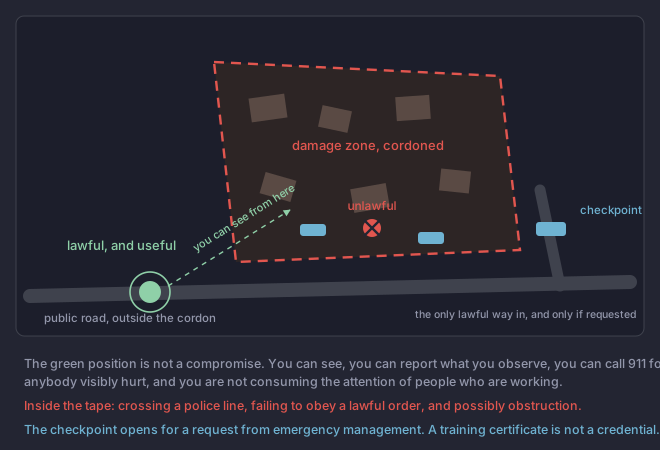
- Crossing a police line or entering a closed area. Typically a misdemeanor, and the tape is the notice.
- Failing to obey a lawful order to leave, to disperse, or to stay out. Usually a separate offense from the first.
- Violating a curfew or a post-disaster access restriction. Common after a major event, and enforced at checkpoints.
- Obstructing or interfering with police, fire or medical responders. The one that carries the most weight, and it does not require you to physically block anybody.
Because looting after a disaster is real, is frequently charged as an aggravated offense during a declared emergency, and is the thing law enforcement is actively watching for. A stranger walking through wrecked houses with a camera is exactly the silhouette they are looking for, and no amount of explaining that you are a trained spotter improves that conversation.
Why you do not self-deploy
This is the part that catches decent people, because the impulse is a good one. Something terrible has happened nearby, you have training and a vehicle, and going to help feels obviously right.
Module 10 lesson 5 described the incident management structure. The relevant property here is that it works by somebody knowing who is present and what they are doing. An unrequested arrival breaks that in three ways at once.
- You consume supervision. Somebody has to work out who you are and whether you are a hazard, and that somebody has other things to do.
- You are unaccounted for. If the scene is evacuated or something collapses, nobody knows you are there.
- You may become a casualty, converting one person who came to help into another person who needs it. Module 8 covered the hazards in a damage zone: live lines, gas, unstable structures, standing water.
Call 911 for anybody injured or trapped, immediately, and give the location properly as module 7 lesson 6 taught. Report what you can see from where you lawfully are, which is genuinely valuable and is your actual job. Offer help through emergency management, not by arriving. Module 10 lesson 5 said find your emergency manager before the season; this is why.
None of this means driving past somebody trapped in a car. Lesson 7 covers rendering aid, and the distinction that matters is between helping the person in front of you and inserting yourself into an organized response. The first is human. The second is a problem.
Check yourself
You arrive at a neighborhood leveled by a tornado. A police line is up. What is the correct sequence?
- Stay outside the line, call 911 for anyone visibly injured, report what you can see, and offer further help through emergency management
- Cross the line to search for casualties, since you are trained and time matters
- Cross the line to photograph the damage for your report, then leave
- Wait outside and do nothing, since responders are already present
Hint
Three of these are wrong, and one of them is wrong in the opposite direction from the other two.
Answer
Stay outside the line, call 911 for anyone visibly injured, report what you can see, and offer further help through emergency management
Crossing the line is a criminal offense and makes you a supervision problem and a potential casualty in an organized response. But the last option is also wrong: you can call 911, you can report what you observe from where you lawfully are, and a damage report from outside the cordon is a real contribution.